Snellere elektronica stap dichterbij dankzij laserexperimenten
21 november 2024
News
 Naar de hoofdinhoud
Naar de navigatie
Naar de hoofdinhoud
Naar de navigatie
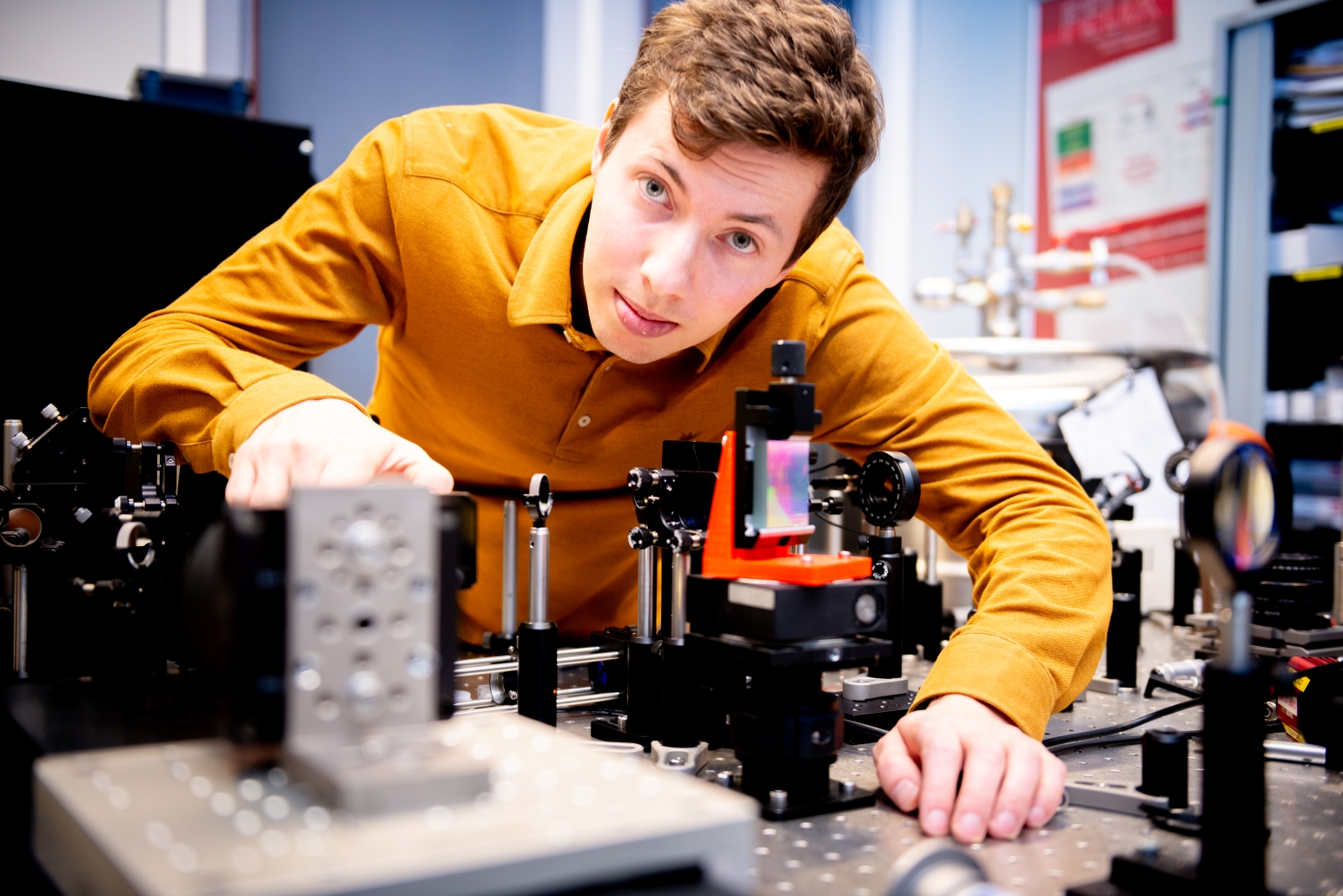
The Condensed Matter Physics group uses the radiation of free electron laser FELIX to study both static and dynamic properties of matter.
Infrared and THz radiation is uniquely suited for studying and controlling systems such as molecules, clusters and complexes, but also electrons in metals and semiconductors, as well as the collective modes of atomic-scale particles. Our department uses the radiation of FELIX lasers for fundamental studies of matter. The research directions range from ultrafast spin and magnetization dynamics, to extreme nonlinear phononics and optics, and to a rational design of matter at an atom-by-atom level.
Meer info over Andrei